Last updated on:
Reading time:
8 min read
Framer vs Figma: When to Design Where in 2026

Zakir Ullah
Official Framer Expert

TRUSTED BY 50+ FOUNDERS
Your design + build partner
Design, Framer development, migration and SEO — founder-led, for US and EU teams.
TABLE OF CONTENTS
SUMMARIZE THIS
ARTICLE WITH AI
Figma and Framer are not competitors. They are consecutive stages of the same pipeline, and most of the confusion about which to use comes from treating a sequencing question as a rivalry. The real question is where the handoff should sit — and for marketing sites in 2026, it has moved earlier than most teams have adjusted to.
TL;DR
Figma for exploration, brand systems, and product UI. Framer for anything that ships as a website.
Designing a marketing site fully in Figma and then rebuilding it is doing the work twice.
Figma's strength is divergence — many options, cheaply. Framer's is convergence — one option, real.
Product teams still need Figma. Marketing teams increasingly do not, past the concept stage.
The handoff should happen at direction, not at pixel-perfect mockup.
What each tool is actually good at
Figma is the best divergence tool that exists. Exploring twelve directions, building a brand system, running a component library that a product team of thirty relies on, collaborating on a flow before anyone commits — nothing beats it, and nothing is close.
Framer's advantage is that its output is the real thing. There is no interpretation step where a designer's intent becomes a developer's approximation. Responsive behaviour is not annotated, it is defined. Interaction is not a prototype of interaction, it is the interaction. For a website, that eliminates an entire category of work and an entire category of argument.
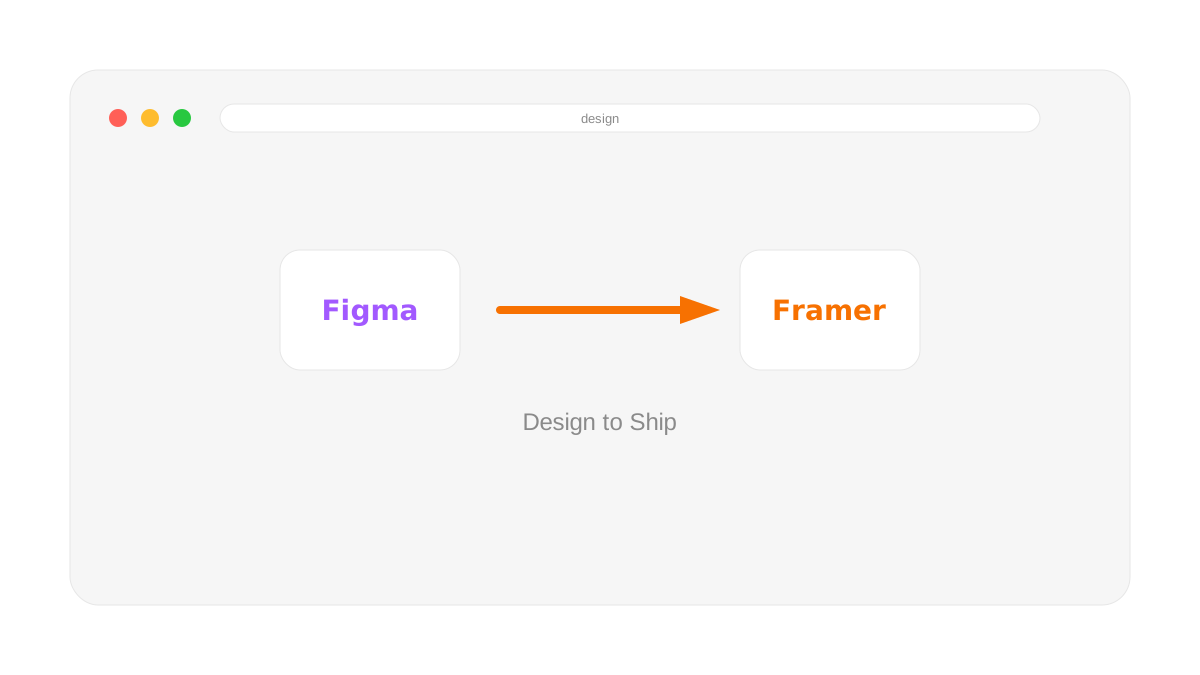
Where the handoff should sit
The traditional pipeline is: explore in Figma, refine in Figma, produce a pixel-perfect mockup in Figma, hand off, rebuild. The rebuild step is where the time goes, and it produces nothing new — it converts a picture of a website into a website.
The pipeline that works better for marketing sites is: explore in Figma until the direction is decided, then move into Framer and refine there. You lose nothing, because refinement in Framer happens against real constraints — real text lengths, real breakpoints, real load behaviour. And you find the problems that only appear at that stage while there is still time to solve them cheaply.
The practical rule: stop in Figma at the moment you would start polishing. Polish is cheaper in the medium the thing will actually exist in.
Where Figma remains non-negotiable
Product UI. Application interfaces have states, edge cases, and engineering handoff that Framer is not built for.
Brand and design systems. The canonical library, tokens, and documentation live in Figma.
Early exploration. Twelve directions in an afternoon is a Figma capability. Framer punishes divergence because everything is real.
Large collaborative teams. Figma's multiplayer and commenting model is still ahead.
Where Framer wins outright
Anything responsive. Defining breakpoint behaviour beats annotating it.
Anything with motion. A real transition beats a prototype of one.
Anything with CMS content, because real content lengths break mockup layouts constantly.
Anything that needs to be live this month.
Anything a non-designer will edit afterwards.
The workflow that works in practice
Concept and direction in Figma — moodboard, two or three directions, the type and colour system, one key screen per direction to make the choice real. Get sign-off on direction, not on pixels.
Then rebuild the chosen direction natively in Framer as components with variants, and design the remaining pages there. Keep Figma as the canonical home for brand assets and tokens; keep Framer as the canonical home for the website. When brand changes, it changes in Figma and propagates to Framer deliberately, not automatically — and that is fine, because it is a handful of tokens.
The objection worth taking seriously
Figma Sites changes the comparison, not the conclusion
Figma now ships its own publishing layer, Figma Sites, which makes "Figma or Framer" sound like a real either/or. It isn't, yet. Figma Sites is a hosting path bolted onto a design tool — SEO and AEO controls live outside the main flow, and there's no equivalent to Framer Agents operating directly on live pages, CMS entries, and metadata. Framer bundles hosting, SSL, redirects, and CDN as defaults, not add-ons. Figma Sites is worth watching if your team never leaves Figma and your site is simple. For anything with a CMS, real SEO requirements, or content that changes weekly, the operational gap is still wide.
Clients and stakeholders often expect to review a Figma mockup, because that is what they are used to signing off. Reviewing a live Framer page is better in every way except familiarity — it is interactive, it is responsive, it is real. The adjustment is a conversation at the start of the project, not a reason to keep doing the extra step.
What to do next
If your team currently produces full Figma mockups of marketing pages before building them, try moving the handoff one stage earlier on the next project and measure the elapsed time. Most teams find the build phase shortens by more than the design phase lengthens. The design service page covers how I run this split.
WORKING ON THIS RIGHT NOW?
I run this exact process for US and EU teams — design, build, migration and the SEO work afterwards. Fixed quote in writing within three days.
NEED MORE INFO?
Frequently asked questions
Is Framer replacing Figma?
No. They are consecutive stages, not competitors. Figma is where product and brand systems get explored; Framer is where marketing experiences ship. Product teams will keep needing Figma.
Should I design the site in Figma first?
Design the direction in Figma, then move to Framer before you start polishing. Producing a pixel-perfect Figma mockup and then rebuilding it is doing the work twice — and refinement is cheaper in the medium the thing will actually exist in.
How do I get stakeholders to review in Framer?
Set the expectation at the start of the project. Reviewing a live page is better in every way except familiarity — it is interactive, responsive and real, so feedback is about the actual site rather than a picture of it.



Founder-led Framer studio by Zakir Ullah — Official Framer Expert & Creator. Design, build, migrate, maintain and grow — led by Zakir from strategy through delivery.
Other
Powered by @Framer
Get 3 Months Framer Free
Let's Connect on Contra
Hire Me on Contra
Ask AI about Framerfry