Last updated on:
Reading time:
8 min read
What Is Semantic SEO? A Practical Guide for Framer Sites

Zakir Ullah
Official Framer Expert
TRUSTED BY 50+ FOUNDERS
Your design + build partner
Design, Framer development, migration and SEO — founder-led, for US and EU teams.
TABLE OF CONTENTS
SUMMARIZE THIS
ARTICLE WITH AI
Semantic SEO means writing for the topic rather than the keyword — covering the entities, relationships, and follow-up questions a reader actually has. It is not a technique you bolt on. It is a decision about what a page is for, made before you write it.
TL;DR
Search systems match meaning, not strings. Repeating a phrase adds nothing once it is present.
A page should own one intent completely rather than three intents partially.
Cover the follow-up questions — that is what "comprehensive" actually measures.
Name your entities explicitly: products, places, people, platforms, prices.
Internal links are how you tell a search engine which pages belong to the same topic.
What changed, and why keyword density stopped working
Older search systems matched strings, so repeating a phrase was a signal. Current systems build a representation of meaning — they recognise that "Framer", "no-code website builder", and "design tool that publishes" refer to related concepts, and they evaluate whether a page covers a topic rather than whether it contains a phrase.
The practical consequence is that the marginal value of the fourth mention of your keyword is zero, while the marginal value of answering the question your reader has next is very high. That is the whole shift, and most on-page advice has not caught up with it.
One intent per page
The most common semantic problem is not thin content, it is mixed content. A page that tries to explain what a service is, argue why you should buy it, list prices, and compare three alternatives is competing against four different sets of results and losing all of them.
Decide the single question a page answers. Everything on the page should serve that question, and the other three questions get their own pages, linked. This feels like more work. It is actually less, because focused pages are easier to write.
Cover the follow-ups, not just the question
If someone searches "how much does a Framer website cost", the literal answer is a number. The useful page also answers: what makes it more expensive, what is not included, how does that compare to alternatives, and how do I know which band I am in. Those follow-ups are what separates a page that satisfies from one that sends the reader back to the results.
A cheap way to find them: type your topic into a search box and read the autocompletes and the People Also Ask box. That is a free list of the questions real people have, and most pages answer none of them.
Name your entities
Entities are the concrete nouns your topic involves — specific platforms, tools, places, prices, standards, people. Vague writing avoids them; useful writing names them. "A popular design tool" tells a search system nothing. "Framer" tells it something. "Framer, Webflow, and WordPress" tells it you are writing a comparison.
This is not keyword stuffing dressed up. It is the difference between writing that could be about anything and writing that is clearly about one thing.
Structure the page so the outline is readable
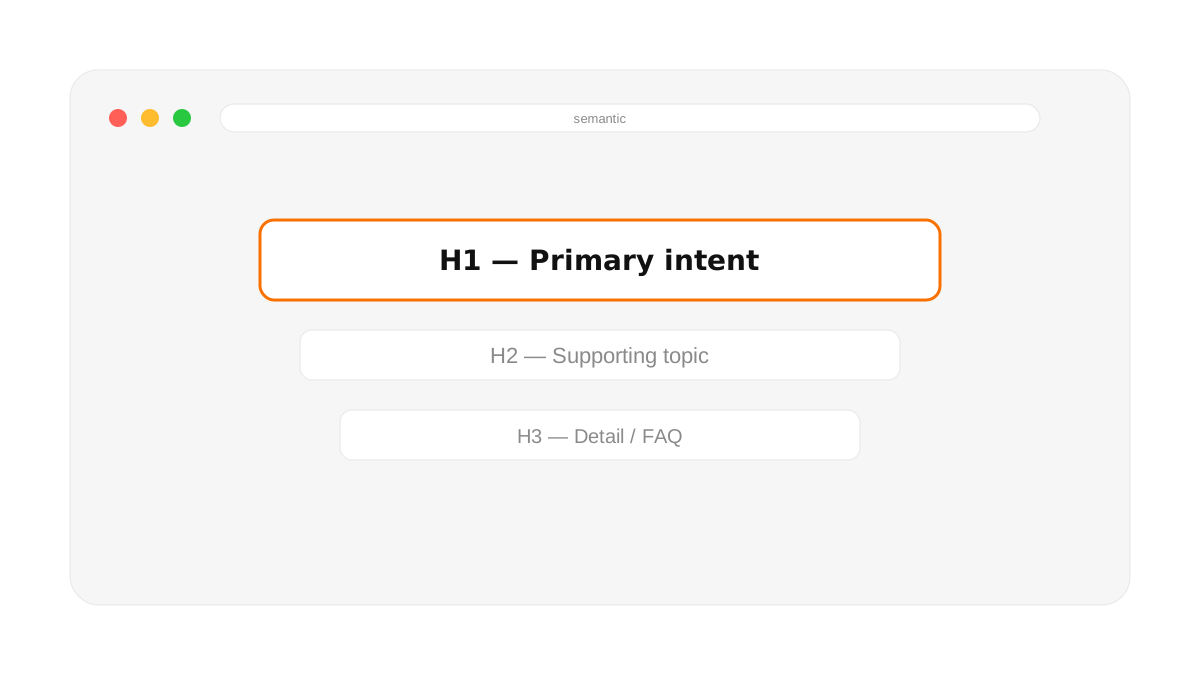
Headings are a machine-readable summary of your argument. If someone read only your H2s, they should understand the shape of the page. That means descriptive headings — "What Framer costs at each tier" rather than "Pricing" — and a hierarchy that actually descends without skipping levels.
On Framer specifically, heading tags come from text style presets rather than font size, so a page can look correctly structured and have four H1s underneath. Check the rendered HTML.
Semantic tags go past headings
Heading structure is the part people fix. The part they skip is that Framer lets you assign real semantic HTML to layout frames too, not just text — a section can be tagged as an <article>, <header>, <footer>, or <nav> rather than shipping as a generic <div>, through the element-type control in each frame's settings. This is what tells a search system (and a screen reader) where the actual content boundary is versus decorative wrapping. A page can have perfect H1–H3 structure and still read as an undifferentiated stack of divs underneath, because nobody tagged the article body as an article. It is a five-second setting per section, and almost nobody sets it.
Build clusters, and link them like you mean it
A topic cluster is a hub page covering a subject broadly, plus focused pages covering its parts, all linked in both directions. The links are not decoration — they are the mechanism that tells a search engine these pages are about one thing and which one is the authority.
Two rules that matter more than people expect. Link with descriptive anchor text, not "read more". And link from the body copy, not just the navigation — nav links appear everywhere and therefore distinguish nothing.
What semantic SEO is not
It is not writing longer. A 3,000-word page that circles one point is worse than 800 words that answer it.
It is not adding an FAQ block to every page out of habit.
It is not synonym-stuffing — swapping in related phrases mechanically reads exactly as badly as keyword stuffing did.
It is not a substitute for having something to say. Coverage without expertise is still filler.
What to do next
Take your three most important pages and ask, for each: what single question does this answer, and does it answer the obvious follow-ups? Most sites find at least one page trying to do three jobs. Splitting it is usually the highest-value hour you will spend. The Framer CMS SEO guide covers how to structure clusters when the content lives in collections.
WORKING ON THIS RIGHT NOW?
I run this exact process for US and EU teams — design, build, migration and the SEO work afterwards. Fixed quote in writing within three days.
NEED MORE INFO?
Frequently asked questions
Is keyword density still relevant?
No. Search systems match meaning rather than strings, so the marginal value of the fourth mention of your keyword is zero. What has value is answering the question your reader has next.
How many topics should one page cover?
One. A page trying to explain a service, argue for it, list prices and compare alternatives competes against four different result sets and loses all of them. Split it and link the parts.
How do I find the follow-up questions to answer?
Type your topic into a search box and read the autocompletes and the People Also Ask box. That is a free list of what real people want to know, and most pages answer none of it.



Founder-led Framer studio by Zakir Ullah — Official Framer Expert & Creator. Design, build, migrate, maintain and grow — led by Zakir from strategy through delivery.
Other
Powered by @Framer
Get 3 Months Framer Free
Let's Connect on Contra
Hire Me on Contra
Ask AI about Framerfry